When a Client Asks to Move the Date: A Script, a Note and a Line in the Sand
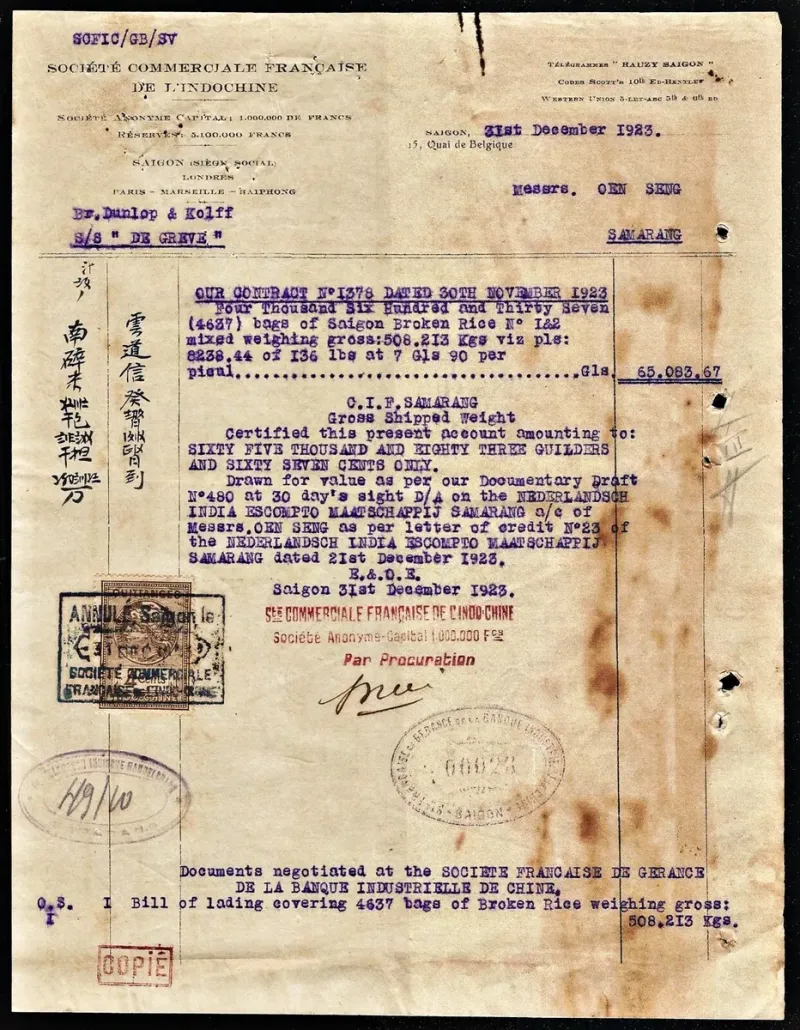
Photo: The Société Commerciale Française de l'Indochine., Public domain, via Wikimedia Commons
The email usually arrives on a Thursday afternoon and is two lines long. Something has come up at the client's end. Could we push the date back a fortnight? It is written in the tone of a small administrative courtesy, and it is treated as one far too often. A moved date is not a calendar edit. It is a decision about capacity, cost and risk, and it deserves the same discipline as any other commercial commitment.
The request is not the decision
The single most expensive habit in client delivery is answering a date-change request in the same hour it arrives. A quick yes feels generous and costs nothing visible at the moment of typing. The cost lands three weeks later, when the team is working around a commitment that was never resourced and a second client's date is quietly squeezed to accommodate it.
Treat the first reply as an acknowledgement, never an answer. That is not obstruction; it is the minimum condition for giving the client a real answer rather than a hopeful one.
Before you reply, get three figures
Capacity. Which other commitments move if this one does? Name them. If nothing moves, the change is probably cheap and should be granted quickly. If two other dates shift, the request is not a favour, it is a re-planning exercise.
Cost. Overtime already booked, subcontractors on notice, materials ordered, storage, sequencing losses. Put a number on it even when the number is zero.
Risk. Contractual exposure on the original date, any downstream dependencies the client has not mentioned, and the precedent set by granting the change.
The script
Use four movements: acknowledge, quantify, offer, confirm.
“Thanks for flagging this — I understand the pressure at your end, and we want to make it work. Before I confirm anything, I need to check two things so we do not create a problem further down the line. Moving from the 14th to the 28th affects our scheduled production slot and a subcontractor we have on notice from the 10th, so there is a cost attached. I can hold the 28th for you if you confirm by Friday, and I will send a short change note setting out what moves, what it costs and what stays fixed. If Friday is difficult, call me and we will find a way through — but I would rather agree the change properly than agree it quickly.”
The movement matters. Acknowledgement without commitment, quantification without accusation, an offer with a condition, and a written record. The closing sentence gives the client a route to a conversation rather than a wall.
The one-page change note
Every date change that survives the conversation gets a note, even when no money changes hands. One page, sent within twenty-four hours, containing:
- Reference and project name.
- Original date and revised date.
- Reason for change, as stated by the client.
- Scope impact — what is added, removed or unchanged.
- Capacity impact — which internal or third-party commitments move.
- Cost impact, with the figure and its basis.
- Notice given, measured in working days from the original date.
- Rebooking fee, if applicable, and the clause or rate card it rests on.
- What does not change — milestones, acceptance criteria, payment terms.
- Approval block with names, dates and a signature line.
The note is not bureaucracy. It is the difference between a change that was agreed and a change that was merely discussed. It also protects the client: a well-run supplier with a paper trail is a safer supplier to rely on.
Where a favour becomes a variation
Small flexibilities keep client relationships alive, and a supplier that treats every half-day adjustment as a contractual event is exhausting to work with. The discipline lies in knowing where the line sits. Three tests work well for most UK SMEs.
- Does it move the critical path? If the change alters the sequence of work rather than just the date on the front of the file, it is a variation.
- Does it require resource beyond the original plan? Overtime, subcontract, additional storage, a second mobilisation — these are costs, and costs belong in a formal change.
- Is it the second request in the same quarter? One adjustment may be circumstance. Two is a pattern, and patterns should be priced.
Any two of the three, and the favour has become a variation. Say so plainly and attach the note.
Rebooking fees without the argument
Arguments about rebooking fees almost always happen because the rates were never published in advance. Put a simple schedule in the proposal or the terms: more than twenty working days' notice, rebooking only, no fee; ten to twenty working days, a stated percentage of the affected element; under ten working days, cost recovery with evidence. Publish it, apply it consistently, and the conversation stops being about whether a fee exists and starts being about when the new date will be.
Consistency is the whole mechanism. A fee waived once without explanation becomes the expectation, and the next refusal becomes a negotiation about fairness rather than a matter of policy.
Say no when the answer is no
Occasionally the honest answer is that the date cannot move without breaking a commitment that matters more. Say it early, say it once, and offer the alternatives: partial delivery on the original date, a phased handover, or a revised scope that fits the original window. A clear refusal delivered in week one preserves the relationship better than a reluctant agreement that fails in week six.
The record afterwards
File the note, update the plan, tell the team in writing, and confirm the new date in the next project update. A date change that is agreed but not recorded is simply a date change that will be disputed later.